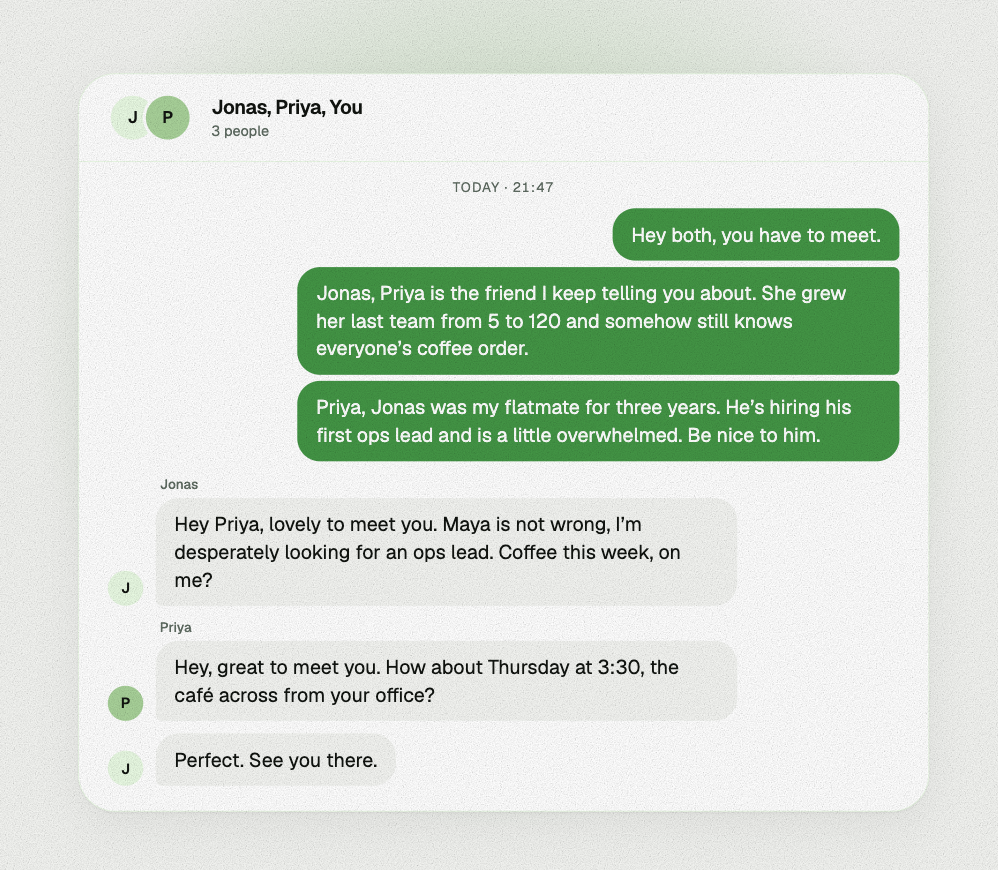
The obvious upfront. Warm introductions convert far better.
The average cold email sequence gets a 4.5% reply rate. Warm intros are reported to get 40–75%. Use warm intros wherever someone you know can vouch for you. Use short, specific cold email only when you actually have to.
Imagine two emails on a Tuesday morning
Picture a busy inbox at 08:00. Two hundred unread messages. Most of them from strangers. One from a friend she has known for years: You should meet Leon. He's building the Soho House for padel.
Guess which one gets opened first.
We have always found people this way. The bar on the corner. The friend who says come along, there'll be people you should meet. Someone who knows someone. The inbox just made it easy to forget.
The numbers
You don't need a study to know a friend's intro beats a stranger's email. But the gap is bigger than most people think.
The average cold email gets a reply four or five times out of a hundred. An introduction from someone the reader trusts gets answered somewhere between four and seven times out of ten. Roughly ten times better, before you have said a word about what you do.
It carries on after the first reply, too. People introduced by someone they know are far more likely to say yes to a meeting, and they tend to stick around once they do.
Cold isn't worthless, though. Not at all. Someone who gets through cold has shown they can make their case to a stranger, and plenty of good friendships and deals started exactly that way. Cold works. It just works less.
Why a warm intro works
Trust travels. When a friend says you two should talk, you borrow years of their credibility in a single sentence.
Someone already checked the fit. Someone explained why. And ignoring a friend's intro feels a little rude, in a way ignoring a stranger never does.
That's all “you know someone who knows someone” really means. It's how people found jobs, flats, cofounders and friends long before anyone had a flooded inbox.
How to give a good warm intro
The best intros ask both people first. It's called a double opt-in, and it keeps everyone's goodwill intact, yours included.
- Get a short note from the person who wants the intro. A few lines on who they are and why this person. You forward it. You don't ghostwrite it.
- Ask the other side quietly. Would you like an intro? No pressure either way. A quiet no costs nothing. A surprise intro costs a favour.
- On a yes, keep it short. One line on each person, one line on why they should meet. Maybe add a personal note to each one.
- Say who moves first. Usually the person who asked.
- Step out. Move yourself to BCC on the first reply.
- Check in a few weeks later. Privately.
Here's roughly what it looks like:
Subject: Clara <> Leon
Hey both,
Clara, meet Leon. He's building the Soho House for padel, and you have the biggest padel community in the city.
Leon, meet Clara. Every Thursday at 19:00, her group fills courts in Berlin and the bar afterwards.
You both believe it needs a new way of networking and connecting people.
Leon, over to you.
Best
Tom
If you can't say in one sentence why two people should meet, they probably shouldn't. Yet.
How to write a cold email people answer
Ok, intro etiquette is clear now, but what if you don't know anyone. Sometimes nobody in your circle knows the person.
Y Combinator has some of the best advice on cold email around, and it comes down to this: three sentences a stranger can read in under a minute. What you do. Why it matters. What you want.
Here are their 20 rules, in the order you'll need them.
Before you write
- Target better, not wider. 100 good-fit emails beat 1,000 random ones.
- Find an uncommon commonality: a real reason it's them.
- Make it all about them. Their problem, in their words.
- Give every email one goal, and cut every word that doesn't serve it.
Writing it
- Keep it short. Under 60 seconds to read.
- Use three sentences: what you do, why it's exciting, what you want.
- Say what you do first, in plain words.
- Lead with your best proof: a launch, growth, a strong team.
- Borrow credibility: past employers, customers, programmes like YC.
- Skip the backstory. No CV, no awards, no origin story.
- Don't flatter. Get to the point.
- Make the ask explicit: advice, an intro, an investment.
- Don't ask for a meeting. Let them suggest one.
- Put the ask on its own line, just before you sign off.
Sending it
- Keep the subject line casual, as if a friend wrote it.
- Write like you talk to a friend. Read it out loud first.
- Send from your company email, with your name in it.
- Send it yourself. No automation at the start.
After you send
- Follow up two to four times, a few days apart.
- If you're ignored, don't take it personally. Check back in a few months.
Those last few matter more than people think. Small, targeted sends get almost three times the replies of mass ones, and following up lifts replies by more than half.
What a good one looks like:
Subject: padel after work
Hi Mia,
I'm building a members' club for padel: courts, a bar and a community space for before and after the game. Our first 200 members joined from a waitlist in six weeks.
We both grew up playing at the old tennis club by the river, and I love what you're building with your female founders club. A few hours on court might be the easiest way for your members to meet outside a meeting room.
Would you like to bring a group of them for an evening on our courts?
Best,
Tom
No I hope this finds you well. No deck. No request for a call. Just one easy question. (Leon, Clara and Mia are made up, by the way.)
So, warm or cold?
Kind of a stupid question, we all know the answer to.
Make use of a warm intro whenever you can. Go cold when nobody in your circle can introduce you. Important: Be easy to introduce.
The best introductions were never written in an inbox anyways. They happened at a long table, a sports club, a friend's birthday, when someone turned and said you two should talk. Use email to get there. Then meet in person.
Go play outside.